
Key facts
- Price
- Free: it is a public square, open day and night
- Best time
- Late afternoon to midnight, when the food stalls set up
- Time needed
- 1 to 2 hours in the evening; many visitors come back every day
- Food stalls
- Around 60 to 120 MAD per person for a full meal (rough guide, November 2026)
- Heritage
- UNESCO Masterpiece of the Oral and Intangible Heritage of Humanity (2001)
- From Majorelle Garden
- About 3 km: 10 to 15 min by taxi, 35 to 40 min on foot
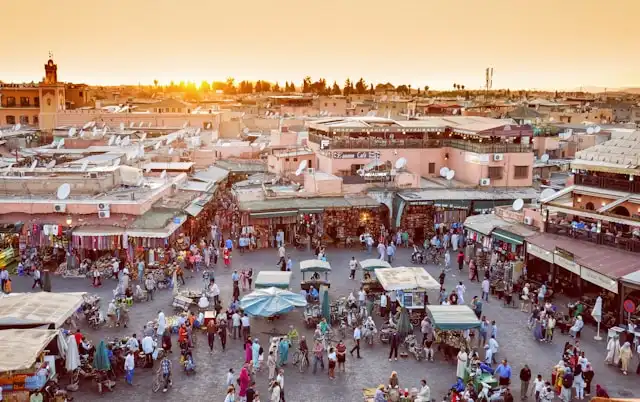
Short answer: yes, Jemaa el-Fna is worth visiting, and it is free. The square is the heart of Marrakech's medina and never closes. Come in the late afternoon and stay into the night: around sunset, dozens of grill stalls set up, Gnawa musicians, storytellers and acrobats gather crowds, and smoke rises over the square. Allow 1 to 2 hours, and keep an eye on prices and on your bag.
The square at a glance: free and always open
Jemaa el-Fna has no ticket office and no opening hours: it is a public square. What costs money is the services: an orange juice, a meal at the stalls, a photo with a snake charmer, a henna tattoo. Food stalls usually display their prices; for everything else, agree on the price first.
The square has two moods:
- By day: orange juice and dried fruit sellers, monkey handlers, snake charmers, henna artists and costumed water sellers. Calmer, and often very hot in summer.
- At night: from about 5 pm (earlier in winter), rows of food stalls with benches go up in the centre. Musicians, storytellers and games draw circles of spectators until around midnight.
What is the best time of day to visit Jemaa el-Fna?
Late afternoon. Head up to a rooftop café to watch the square change at sunset, then go down for dinner at the stalls. The crowds peak between 7 pm and 10 pm. During Ramadan the square comes alive mainly after the fast is broken at sunset.
What happens at Jemaa el-Fna at night?
- Dinner at the stalls: skewers, merguez, fried fish, tagines, harira soup and, for the curious, sheep's heads. Stalls are numbered and display menus.
- Snails: a bowl of spiced snail broth, served at separate stalls, is a local speciality.
- Fresh juice: orange juice squeezed on the spot for a few dirhams. Check the posted price before ordering.
- Performance circles: Gnawa musicians, storytellers (in Arabic or Amazigh), boxers and bottle-fishing games. If you watch, you will be asked for a coin: 5 to 10 MAD is enough.
- Rooftop cafés: Café de France and Café Glacier, among others, overlook the square. You usually have to buy a drink to go up.
- The souks start on the north side of the square, and the Koutoubia mosque is a 5-minute walk west.
A street food tour booked on GetYourGuide lets you taste several specialities with someone who knows the good stalls. To simply walk around, you don't need a ticket.
How much does food cost at Jemaa el-Fna?
Expect around 60 to 120 MAD per person for a full meal at the stalls, drink included. This is a rough guide from November 2026 and depends on the stall and what you order. Bread, olives and sauces placed on the table are sometimes charged, so ask before you tuck in. Pick a stall busy with Moroccans, where food is cooked in front of you.
Scams to avoid
- Henna: some artists grab your hand and start without asking, then demand a high price. Pull your hand back and say no firmly. Avoid "black henna", which can contain irritating chemicals.
- Animal photos: photographing a snake charmer or monkey handler costs money, sometimes a lot. Agree on the price first, or skip it; Barbary macaques are an endangered species, and keeping them chained for tourists is widely criticised.
- Padded bills: check the menu and the bill item by item.
- Fake guides: if someone says your street is closed or offers to walk you to your riad, decline politely and use your map.
- Pickpockets: keep your bag and phone in front of you in the crowd.
More advice in Is Marrakech safe? and our guide to tipping in Morocco.
Why is Jemaa el-Fna famous?
For centuries Jemaa el-Fna has been Marrakech's meeting point: a market, a stage and the crossroads between the medina, the souks and the Koutoubia. In 2001 UNESCO proclaimed its "cultural space" a Masterpiece of the Oral and Intangible Heritage of Humanity, for its storytellers, musicians and street performers. The surrounding medina has been a World Heritage Site since 1985.
What does "Jemaa el-Fna" mean in English?
The meaning is debated. "Jemaa" means mosque or gathering, and "fna" can mean courtyard or annihilation. It is often translated as "assembly of the dead", a reference to the public executions that tradition says once took place on the square.
Getting there and where to stay
The square is in the centre of the medina, a few minutes' walk from the Koutoubia. From Guéliz or Majorelle Garden (about 3 km), a petit taxi takes 10 to 15 minutes; taxis drop you at the edge, as cars can't enter the square. To stay nearby, see our best riads in Marrakech, and to plan your days, our Marrakech itinerary.
After the square, continue to Majorelle Garden, or take a day trip to the Ouzoud Waterfalls or Aït Ben Haddou.
FAQ
Is Jemaa el-Fna worth visiting?
Yes. It is free, unique and the liveliest place in Marrakech, especially in the evening when the food stalls and performers take over. Go at sunset, watch from a rooftop café first, then eat at a busy stall. Expect crowds and persistent sellers.
What is the best time of day to visit Jemaa el-Fna?
Late afternoon into the evening. The food stalls set up around sunset and the performances run until about midnight. Mornings are quieter but much less spectacular.
How much does it cost to visit Jemaa el-Fna?
Nothing: it is a public square open day and night. You only pay for services such as food, juice, photos with performers or henna. Agree on any price that isn't posted before accepting.
How much time do you need at Jemaa el-Fna?
One to two hours in the evening is enough to watch the sunset, walk the stalls and eat. Most visitors pass through several times during their stay, since the square sits between the souks and the Koutoubia.
What does "Jemaa el-Fna" mean in English?
The meaning is debated: "jemaa" means mosque or gathering and "fna" can mean courtyard or annihilation. It is often translated as "assembly of the dead", after the public executions once held there according to tradition.
Is Jemaa el-Fna safe at night?
Yes, it is busy and policed. The main risks are pickpockets in the crowd, padded bills and pushy sellers (henna, photos, fake guides). Keep your belongings in front of you and agree on prices in advance.
How far is Jemaa el-Fna from Majorelle Garden?
About 3 km: 10 to 15 minutes by petit taxi, or 35 to 40 minutes on foot via Guéliz and the Koutoubia.